Jekyll2024-02-20T15:49:42+00:00https://tom.chadw.in/feed.xmltom.chadw.inIntermittencyTom ChadwinUpdatable views in PostgreSQL: Why and how?2023-07-20T00:00:00+00:002023-07-20T00:00:00+00:00https://tom.chadw.in/wrote/UpdatableViewsUpdatable views in PostgreSQL: Why and how?
A longstanding client requested a minimum viable product (MVP) for updating some of their data via a web front end.
Designing an MVP dictates the quickest development path possible to a deliverable solution. The web front end itself was the MVP, as the database already existed. Not touching the database would give us more time to work on this front-end GUI.
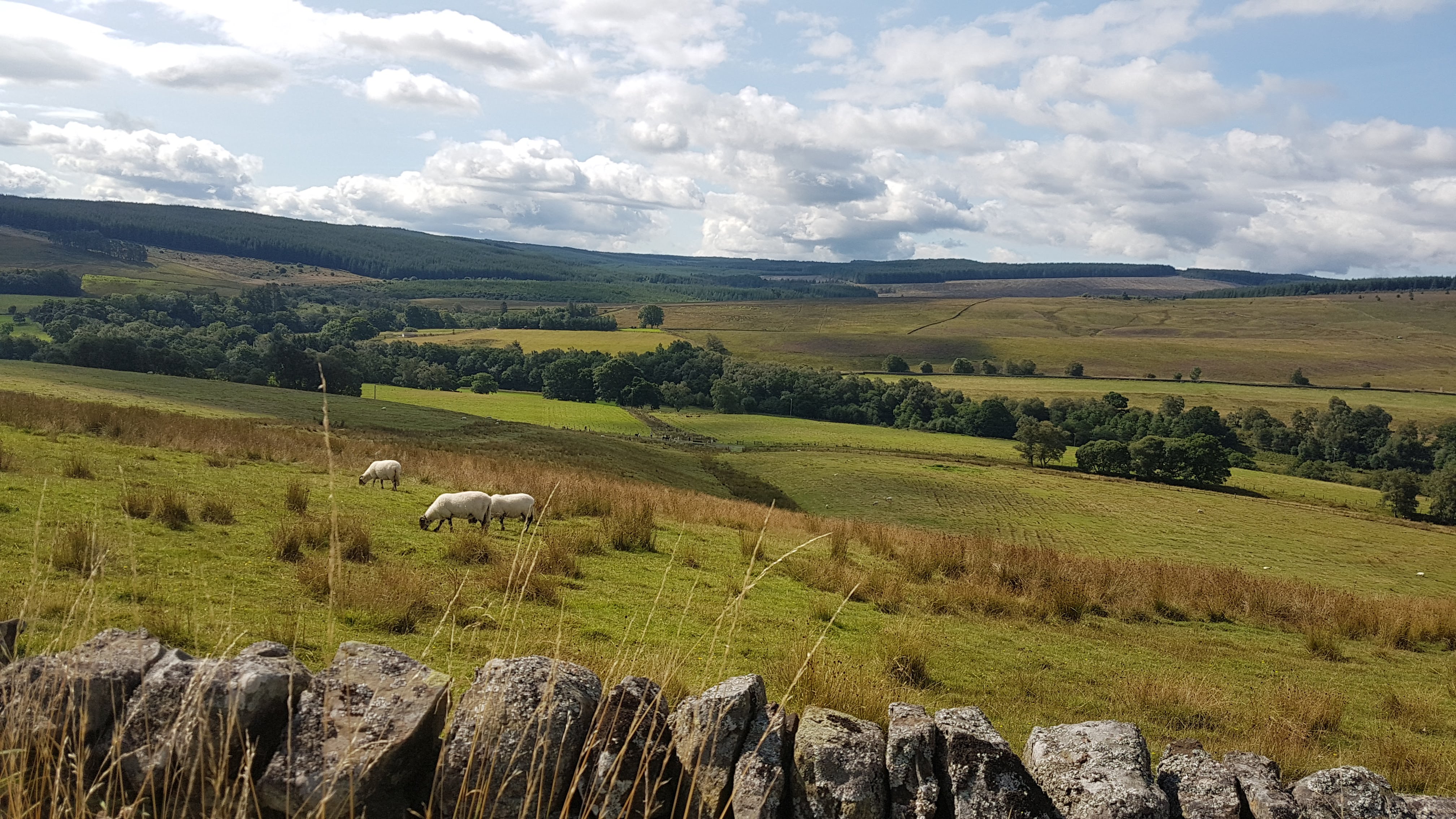
A nice view
However, there was another stronger reason not to touch the existing database: it is live, the public querying it every day via website and app. It therefore made no sense to try to re-engineer live data for an MVP.
A final reason for not touching the existing database is that it stores the data in question in related tables. While useful for storing richly structured data, this is not ideal for geographical representation, and especially not for spatial use (in other words, on a web map). GIS works with features, expecting them to have a flat list of properties, not related tables of attributes.
My colleague Matt mentioned a technique he had used on the another project for the same client: updatable views. This technique had great potential for this MVP.
Databases store data in tables. Many systems query those tables directly, retrieving the data and presenting it to the user. However, databases also support views. Views don’t have to be of single tables, but can be populated by complex SQL statements. They are often therefore used to gather data from many tables in a highly relational database into a human-readable form. In our case, they solve the problem of converting relational data in the database into flattened properties for the webmap features.
Database views are traditionally read-only. Their primary purpose is the presentation of data to the client. But Matt had mentioned updatable views. How is this done?
This project’s database is PostgreSQL. While at a broad concept level, views are read-only, PostgreSQL does allow views to be updated: passing the updated values to the table on which the view is based. However, there are severe limitations on which views can handle updates in this way. Our views did not fall within these limitations, so we have to do some more work to get this up and running.
Database triggers are “listeners” which can be assigned to fire when specific events occur. For example, a trigger can be created which fires when a specific table’s data is updated. A trigger function is called, which carries out whatever ancillary function is required – perhaps inserting a row into another table.
A view can have triggers, and although a view is read-only, it can still have a trigger which fires when an UPDATE query is made against it.
This fact opens up a whole model of abstraction within the database itself: store the data in tables, create views, present the views’ data to the client, and query the view for create/review/update/delete (CRUD) operations. Add triggers on the views to call functions to update the tables. This abstraction is extremely valuable in our use-case: we don’t want to touch the underlying data structure at all, but still want to be able to update the underlying data.
So how does it work? For each view which you want to be able to update, create a trigger for each CRUD operation you want to support:
ON BEFORE INSERT
ON BEFORE UPDATE
ON BEFORE DELETE
We set these triggers to fire BEFORE the events above because none of those SQL operations can succeed on a view: you can’t INSERT, UPDATE, or DELETE something which is read-only. Each trigger calls a respective trigger function which carries out an INSERT, UPDATE, or DELETE on the related tables where the view’s data is stored.
But how do we get the new data which the trigger function needs to update the tables? We coded the client to carry out the following pseudocode:
UPDATE view SET view.field = CHANGED_VALUE;
This fires the ON BEFORE UPDATE trigger, which calls our custom UPDATE function:
UPDATE table SET table.field = CHANGED_VALUE;
But how do we pass CHANGED_VALUE from the original query into the triggered function? In PSQL (PostgreSQL’s SQL dialect), we use the NEW keyword:
UPDATE table SET table.field = NEW.field;
The NEW object has all the same properties as the original UPDATE had columns, with the values assigned in the original query.
And that’s it. We can make our view as complex as we want (I could write a whole post about using CROSSTAB to destructure related tables), and then restructure the flat input and update whatever underlying tables we want. The table structure is never touched.
Thanks to Matt for sharing this valuable technique.
]]>Tom ChadwinReturning to games2023-03-17T00:00:00+00:002023-03-17T00:00:00+00:00https://tom.chadw.in/wrote/GamingReturning to games
Viking Raiders was a long time ago. That wonderful, innocent age of gameplay
alone, and writing games in Basic, is what gave me the career I have today.
A few forays into PC gaming followed: Civilization, one of the Star Wars ones,
Myst (completed), and Riven (incomplete) were followed by years of nothing,
until a little phone gaming (well, really an extension of my middle-aged
enthusiasm for pool by way of 8 Ball).
The gift from a very kind colleague of an XBox One opened the door a crack.
Leaving others to their Roblox, I started out with Red Dead Redemption,
which had intrigued me since finding out about it when it launched during
my non-gaming years.
Red Dead Redemption is simply miraculous. It was my first experience of a
game both vast in scale and minute in detail. The realism of the trackways
through a turn-of-the-century Western landscape join with a tangible
plot and rendering which is good enough to create a reality which compels.
I’m only at the start, but I could watch it for hours.
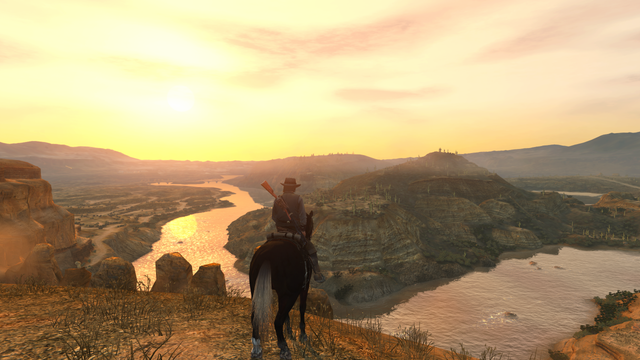
Red Dead Redemption
Red Dead Redemption is hardly suitable fayre for the brood, however. By
chance, my youngest and I stumbled on Unravel. This game is a natural
successor to Myst in its beautiful rendering, disguising simple physical
gameplay. Four factors elevate it way beyond its precursor.
The visuals are simply beautiful: lush, detailed, small in scale but big
in realization. The real-world physics remind me of the peerless Thrust.
The complexity of the puzzles verges on the fiendish.
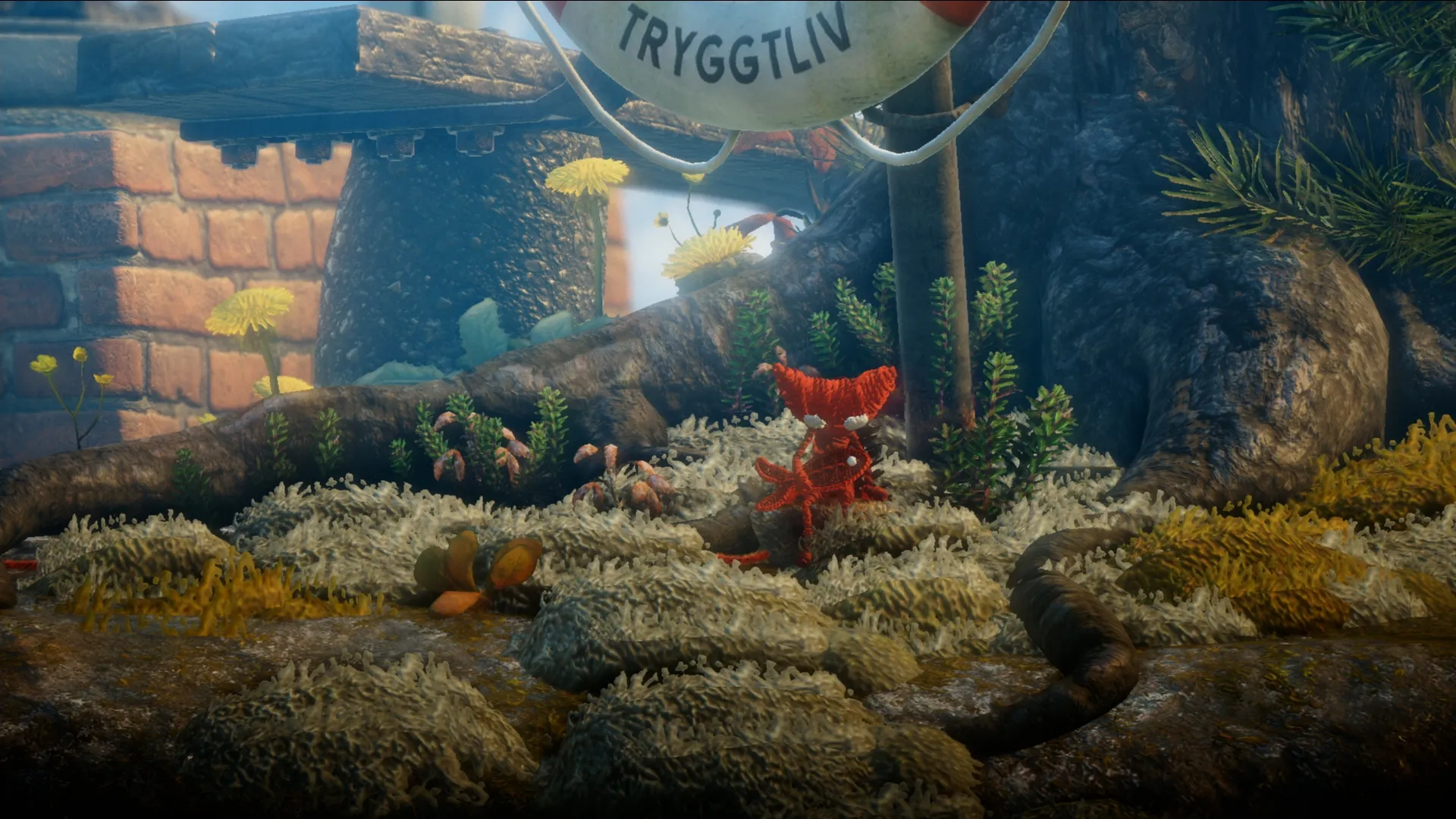
Unravel
But everything is trumped by the profoundly evocative atmosphere. Scandi
hygge pairs with a gently compelling soundtrack to tell an achingly
nostalgic story, almost melancholic in its depiction of past childhood.
So that’s me, at least for the moment. I can’t see myself wanting any other
games until I’ve completed these two. While each has a sequel, only Red
Dead 2 seems to have a decent reputation. So I think I’ll be set for some
time. Though the lure of Hadrian’s Wall in Assassin’s Creed is beguiling.
I read The Weirdstone of Brisingamen when I was ten. Like many others,
fantasy was a passion for a time, and, along with inevitable Tolkien,
The Weirdstone stuck with me for some years. I remember little about it
now, other than a sense of darkness.
Many years later, I was lucky to attend a talk given by Garner. It was a
storytelling event held in the reconstructed Anglo-Saxon hall of Thirlings
at Bede’s World in Jarrow. My older brother had been a Garner fan for years,
but all I had was that vague childhood half-memory.
Garner’s talk was like nothing I had ever seen or heard. It told of his
experiences writing his imminent short novel Thursbitch.
I’ve never before or since heard someone hold the room so completely, as
he dug us down into the earth of his new book.
After reading Thursbitch, I sought out all of Garner’s fiction. The Weirdstone
didn’t stand up wonderfully well to an adult reader, and the other two
children’s books were similarly unmemorable. The Stone Book Quartet gave a
glimpse of what was to come, in its peerless evocation of childhood.
Then came The Owl Service. I confess almost to having my breath taken away
while reading this short book for the first time. The Welsh valleys act as a
protagonist, perhaps emphasized to this English reader in the contrast drawn
between its middle-class English and working-class Welsh characters. Class,
and cultural and intellectual hatred,
soak every character, and I had my first glimpse of Garner’s horrific
perception of his childhood and adolescent self, and his unwavering certainty
in his own intellectual superiority. It’s a tough read, but a compelling one.
The Owl Service is rightly remembered, of course, for how it sinks
its landscape and protagonists through the fabric of history and nature. This
is Garner’s genius. Even in this early work, he creates echoes
between ages, made concrete in elemental man-made objects. His is the liminal
world between the natural and the unexplained. And that threshold is one of
horror.
The Owl Service is everything which Jacqueline Wilson fails to achieve. It’s
a children’s book about misery and anger. Red Shift takes these themes to another
level for a slightly older audience.
Red Shift strips out the bucolic setting of The Owl Service, rejecting its
beauty for the industrial hinterland of Garner’s beloved Cheshire. The themes
of class and intellectual snobbery infect one of the three narratives which
run in parallel and intersect in this disturbing, upsetting, and raging work.
Each strand distances itself from the reader quite deliberately in its characters’
language. Modern-day irritating intellectualism, seventeenth-century Cheshire
dialect, and US military jargon in the mouths of Roman legionaries all unsettle.
Red Shift’s multiple narratives allow Garner, quite astonishingly, to place massively
greater emphasis on the echoes and touches between ages, again channelled through
the ancient man-made. However, because of the explicit narratives in different
periods of history, this totemic relationship is set free to become vastly more
impressionistic. The conscious uncertainty amplifies his
central theme of inter-generational historic emotional resonance to an astonishing
degree, and the book chills with dread.
The splitting of the narrative into three allows and requires Garner’s overweaning
evocation of place to sharpen and localize from The Owl Service’s Welsh Valleys to
Red Shift’s Mow Cop. Again, the historic and man-made act as a conduit between ages,
in both the land and the ancient axe-head, which inherits the mantle from The Owl Service’s
megalith and spear-head.
Red Shift is despair. “Not really now not any more.”
As described, I read Thursbitch, last in this undeclared trilogy, before the other
two. I was still buzzing with dread and fascination from Garner’s mesmerizing talk.
Thurbitch pares Red Shift’s three parallel narratives down to two. The present-day
protagonists have continued to age with Garner, and death is constant. While hateful snobbery persists,
Garner’s characters recede, and his land looms ever larger. The Owl Service had the
iconic Welsh valleys. Red Shift had a local curiosity and landmark. Thursbitch gives
its name to the novel, but is otherwise unremarked, to the best of my knowledge.
The landscape’s lack of historic or monumental significance
allows the novel’s setting to drop all cultural baggage and creep its own quietly
screaming path. The horror of The Owl Service’s myths, and of Red Shift’s history,
becomes purely of Thurbitch’s earth.
Again, the ancient man-made bridges the narratives and the ages. The seventeenth-century
Cheshire dialect, crisp and lilting in Red Shift, becomes rhythmical and beguiling in
Thursbitch. While the former’s characters battled in extremis, the latter’s chthonic
archetypes mutter and lilt, “think on”.
Treacle Walker
was up for last year’s Booker. To me, it was the faintest echo of the
unflinching horror of this most English trilogy. If Garner had won, in my mind, it would have been
in recognition of these unforgettable books.
Walk and do. Walk and do. Walk and do till all is done.
My esteemed colleague Leigh prompted us to embrace the colour green
to raise awareness of World Mental Health Day this Monday just past.
This resonated with me. While currently owning no green clothing
other than my socks, I thought writing, not wearing, might contribute.
I don’t know where it started, but green’s always been my joy.
Perhaps Dad’s insistence that green was his lucky colour
initially hooked me. He would wear a green tie on occasions when he
hoped for luck, along with green cufflinks. I tried that with
underwear on Newcastle matchdays. It worked as well as could be
hoped.
These days, a couple of tangential greens make me happy. We were
invited into Greenhaugh Primary School to hear the children read and
sing for the first time since lockdown. I’ve written about Greenhaugh
before, and while all of our mental
health undoubtedly suffered in the fight to save it, the fight was
worthwhile, and this visit lifted my spirits.
I used to play football extremely badly. Moving into the middle of
nowhere twenty years ago (not to mention anno Domini) made this harder, and it fell by the wayside.
I didn’t realize how much I missed participating in a competitive game
until I was asked to join the mighty Blackcock
pool team. Perennially bottom of the league, the green baize
nevertheless calls me, and I love the game.
But it’s green in its common meaning which lies at the heart of the
matter, of course. Someone once commented that one’s happiest childhood
memories are never indoors. Camping and narrowboating certainly rank
among mine.
Although I grew up a city boy, my wife
persuaded me to move into the green yonder. While we worried that we
both might struggle, in truth we’ve never looked back.
She had form. A short break as students had us walking a portion of
the Ridgeway, from Swindon to Avebury via Uffington. Sunburn and blisters
didn’t dilute the joy of a slow journey through the English
countryside.
We doubled down on narrowboating, and have been on the canals several
weeks a year for over fifteen years. Landscape and nature are balm.
Seeing HS2 carving swathes through the South Oxford summit was one of
my saddest memories.
Mum said she once heard a professor say on the radio that she firmly
believed that if you take an interest in the natural world, it will
hold your interest for the rest of your life. Maturin would agree.
]]>Tom Chadwinqgis2web: The Story So Far2019-10-30T00:00:00+00:002019-10-30T00:00:00+00:00https://tom.chadw.in/wrote/qgis2webTheStorySoFarqgis2web: The Story So Far
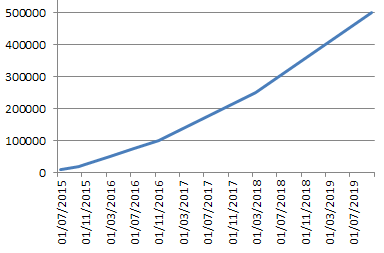
qgis2web has now been downloaded from the official QGIS plugins repository
over half a million times. It’s the sixth most downloaded QGIS plugin of all
time. This is a short piece about its history.
qgis2leaf and qgis-ol3
In 2014, Riccardo Klinger created qgis2leaf, which exported QGIS projects to
Leaflet webmaps. Around the same time, Victor Olaya created qgis-ol3, which
did the same, but exported to OpenLayers webmaps. I got involved with
qgis2leaf, as we needed it for work (adding support for WFS, as I recall).
I’d never coded in Python or used Qt before, nor used git, but as languages
and source control systems go, they’re easier than many.
Riccardo and I continued to work on qgis2leaf intensively, adding considerably
to its functionality. It was a really exciting time for me. Learning to code
in Python (albeit not at all well) was fine, but what I’d never really
experienced before, as an amateur coder, was having the public use code I had
written. It was a big step, but a good one, having to deal with issues
reported by users I had never met, and never would.
qgis2web is born
In 2015, Paolo Cavallini, now chair of the QGIS Project Steering Committee,
got in touch with Victor, Riccardo, and me to suggest that it would help users
if qgis2leaf and qgi-ol3 were merged. Both did essentially the same thing, but
using a different Javascript webmapping library. We all agreed, and work
started on qgis2web. Huge thanks are due to Paolo for the suggestion and
support.
qgis-ol3 had a GUI with more functionality than qgis2leaf. Specifically, it
had a preview window. This was important, as there was a huge benefit in
migrating qgis2leaf to the same GUI. It meant that the proposed merge had
advantages for qgis2leaf (as was), as well as for end users. This certainly
motivated me, as did Victor’s elegant Python in qgis-ol3.
I lifted all the qgis2leaf code, placed it alongside the qgis-ol3 code, and
slightly altered the GUI to allow users to switch between the two. It worked,
but really was in essence two plugins side-by-side, with all the duplication
that implies.
Improvements and tests
Over time, common functions from the two original plugins were deduplicated,
and the code became a little less unwieldy. However, I worried about releasing
buggy versions–it did happen once or twice. I had become aware of automated
testing, via a service called Travis, hooked into Github. The idea is that,
every time a change is made to the source code, a suite of tests is run to
ensure that no regressions have been caused.
I thought for some time that this would be an incredibly useful service for
qgis2web. With so many variables (layer types, renderers, styles, options),
it was already impossible to be rigorous in checking manually that nothing was
broken.
With a lot of help from Akbar Gumbira, we finally got it all up and running.
It fundamentally changed the reliability of qgis2web across versions, even
though wrangling code and reference output files can sometimes be frustrating.
Collaboration and support
Paolo remained a big supporter of qgis2web. As part of a Faunalia contract, he
commissioned Nyall Dawson to work on the plugin. This was brilliant news, but
the idea of a QGIS core dev looking at my code was also somewhat daunting.
Sure enough, Nyall fundamentally refactored the entire plugin, decoupling the
GUI from the export process. His work remains to this day, and the plugin is
the stronger for it. I must also give credit to both Jürgen Fischer and Matteo
Ghetta for their help during this period of development.
It must be said that this work did expose some inherent limitations of
qgis2web for some projects. At the end of the day, QGIS, Leaflet, and
OpenLayers are very different pieces of software, and the area of functional
overlap between the three is significantly smaller than the functionality of
each individually. If there were one constant frustration in working on a
piece of software used widely by strangers, it would be the struggle to manage
expectations, especially given that many users have strong GIS knowledge, but
less strong knowledge of the web and its inherent performance limitations.
QGIS3
The changes from QGIS2 to QGIS3 were enormous. Python was upgraded from v2 to
v3, and Qt from v4 to v5. In addition, so many things in the QGIS API changed.
It was a massive job to produce a compatible version of qgis2web, and it would
have been basically impossible for me without the Travis testing environment.
However, it all got done, and the concomitant tidying and refactoring of the
source code was a massive collateral benefit.
There have been two major version upgrades to OpenLayers and one to Leaflet
during qgis2web’s life, and another OpenLayers one is imminent. The work never
stops.
Burnout
After the big push to make a QGIS3-compatible version, I did slow down. The
eighty-twenty rule kicked in, with remaining issues being either less
significant or harder to solve. My attention was also elsewhere (but still
using QGIS!). As a result, development slowed down significantly.
Things have picked up again, but I doubt I’ll work as intensively on it again.
It’s frustrating, but we’re all human.
Significant help
Many other people have contributed to qgis2web. I specifically want to mention
a few here, and apologies to those I miss out through forgetfulness.
Luca Casagrande coauthored qgis-ol3 with Victor. He has continued to support
qgis2web, including fixing some problems which totally had me stumped. He also
worked on qgis2web with Paolo at a QGIS developer’s meeting.
Nathan Woodrow wrote a module from scratch to convert QGIS expressions into
Javascript, and hence make them available in qgis2web. It’s a beautiful bit of
code, all the more impressive since I get the impression that Nathan doesn’t
really work with Javascript.
Thomas Gratier wrote an OpenLayers plugin from scratch to allow searching by
layer attributes. Handling the diversity of possible search sources was a
challenge, which he overcame effortlessly.
Per Liedman wrote a Leaflet plugin from scratch to support multiple symbol
layers. He also helped a great deal in implementing Leaflet.VectorGrid to
support vector tiles.
Iván Sánchez Ortega has been a huge help also in Leaflet.VectorGrid and more
generally in Leaflet and vector tile matters.
Ola Kovalev made significant contributions including developing OpenLayers
clustering from scratch. Ola is notable in being happy to learn and then
implement tests alongside her work, going through the same occasionally
frustrating learning process that I had.
Paul Dos Santos implemented overall map styling from scratch. One of my
frustrations is not having taken his work further–a fairly simple task, but
one which never seems to get to the top of the list.
Martin Boos wrote and maintains the QGIS plugin Vector Tiles Reader, without
which none of the vector-tile functionality of qgis2web would be possible.
Ed Boesenberg developed multi-unit measurement in OpenLayers, and also
deserves massive thanks for his constant help in answering queries on the
qgis2web repo.
New maps
For the first time since it was created, qgis2web has a new output format.
Mapbox GL JS excels at rendering vector tiles, and has many other key
advantages over Leaflet and OpenLayers. However, it should not be used
indiscrimiately, as the other two libraries still have their advantages. In
addition, the currently implemented feature-set for Mapbox GL JS in qgis2web
is much, much smaller than that implemented for Leaflet or OpenLayers. This
will improve over time, but is unlikely to be quick. I hope to write a
separate piece investigating the core differences between the three libraries,
but that’s a job for another day.
Huge thanks are due once again to Victor Olaya, who has developed bridge-style
at GeoCat. It does all the style conversion work, and I can see qgis2web
offloading its OpenLayers and Leaflet style conversion code to it in the
future. Other projects will then be able to make use of the routines.
A quick note, by way of clarification. Mapbox, the company, provide many
services. Mapbox GL JS is one of their products, and is completely open
source. qgis2web only exports standalone Mapbox GL JS maps. It doesn’t use any
Mapbox services–no hosting, no styles, no data. It’s key to refer to the
export format as Mapbox GL JS, to keep it distinct from Mapbox the company and
its ecosystem of hosted services. Many thanks to Vladimir Agafonkin for
putting me in touch with Kathleen Lu at Mapbox, to ensure that Mapbox are
happy with the approach.
Where next?
Developing more functionality for the new Mapbox GL JS exporter is top of the
list for me, as qgis2web has reached some level of maturity with its Leaflet
and OpenLayers exports (though one day we might get layer groups working
properly). There will no doubt be many issues with Mapbox GL JS exports, so
handling those will probably also take priority.
More important than these, however, is making qgis2web’s capabilities more
readily transparent to the user. We need massively improved error reporting,
with an emphasis on feedback on unsupported QGIS features in an export.
Alongside this, a compatibility table would also help users decide which
export format to choose. With the launch of the new Mapbox GL JS exporter,
this has now become much more critical.
And documentation, obviously.
Bellwether
Beyond the code itself, I’m extremely proud of qgis2web for a couple of other
reasons. One is having turned code into software–in other words, supporting
users, implementing testing, and also promotion, which is a big part of the
project. Documentation still lags horribly, but that’s a badge of honour for
an open-source project.
Above all, though, I’m proud that qgis2web represents consistent growth in a
sector I love–open-source, provider-agnostic software. To my delight, there
has been no real plateau in growth:
qgis2web downloads over time
Despite the recent Google Maps price hike, the trend away from
non-provider-based webmaps sadly continues. qgis2web tries its best to help
those who want to remain truly independent and in control.
]]>Tom ChadwinA walk without Max2019-06-07T00:00:00+00:002019-06-07T00:00:00+00:00https://tom.chadw.in/wrote/AWalkWithoutMaxA walk without Max
Walking further out of town on the road where I work, you climb a hill to some
woods. You can avoid the main road and find more interesting ways to get
there, but my walk without Max today only really started after the climb.
Limited lunch time meant we used to drive up each day, until my guilt at
unnecessary driving pushed us to alternative routes, and this walk was
consigned to our past together.
An unprepossessing start, parking in a muddy narrow layby, and tiptoeing
nervously along a short stretch of fast rural road with no pavement, leads to
a wide track. Straight as an arrow, it runs at right-angles to the road, into
the forest. At the junction is a gloriously overgrown cottage, with improbable
bamboo hedge.
I’ve never liked forests much. The trees obscure the land and the sun, and
one’s horizon is shortened. Pragmatism won the day, though, as tree cover has
its benefits in the English climate. Max was black and tan, so as well as
protection from inevitable rain, some shade was also welcome on our summer
walks.
While the wide track marches on into the distance, various openings in the
stone wall to the right grant access into the forest itself. One can pick out
any number of routes, but the functionally redundant parallel course to the
track always suited us best.
Where this almost-path rejoins the main track, a wider forest path slopes down
to the right. Taking various measures to avoid incursions of water, one
passes what I can only imagine are four redwoods. What these giants are doing
among this otherwise commonplace English plantation is a mystery, and a
beguiling one.
The path narrows as it skirts the private grounds of the large house at the
heart of the woods, and then slopes further downhill. This path seems
ancient – a wide holloway, again very straight, ending at a tiny stream.
I paused here, as here is compensation for the lack of view so far. Through a
fence is open countryside, of the most beautiful rolling English kind. Max and
I would always pause here, I to smile as my heart was lifted by the view, he
impatiently. I never found out what horizon was revealed, and this view
remains to this day precious to me, as a shared memory with him, silent and
content. Today it’s just me.
Across the stream, the path flattens out, as it gently curves round to the
left. This is more traditional forest pathwork, not the ageless sunken path we
just descended. But to the right, a fork slopes sharply down.
We must have walked on past this fork hundreds of times, but one day, taking a
break from over-cheerful enthusiasm from a software trainer, we turned right.
The gradient rapidly increasing, the path became narrower and narrower,
steeper and rougher, descending a conifer-root stairway, and nearly meriting
the sit-and-slide approach.
As a younger man with a young mongrel, evidently largely collie, I scampered
down this path. For years after, I couldn’t find it again. But three years
ago, Max and I being older and more nervous, the ground slippery with falling
rain, and with my nine-month-old son strapped to my chest, the precipitous
nature of this descent was all too apparent.
I wasn’t going to turn back, though. Max and I had not been here for maybe ten
years, and I wanted him to see it again. Sentimental thoughts of sharing it
with my son, and even of this being a boys’ trip out, made me slither down.
My wife and I do everything together, with our family. These weekday lunchtime
walks with Max were my time without her, without talk. Max and I would cover
the ground, and see where our journey took us. I wonder if one day I’ll take
my daughter here. She’d love it, but life gets in the way, and there is a
little part of me that wants to keep this walk to myself. Me and Max. Today
it’s just me.
The worst of the sheer path negotiated, this break from IT training yielded
the most amazing surprise. An unexpected river, with yellow sandstone cliffs,
and a sandbank shore in the bend. This felt like our own discovery. Today was
only the third time I’ve ever been there, and it still takes my breath away. I
jumped onto an island stone to be surrounded by the flow, and saw a tiny fish
dart away.
Water makes me think of my dad. He was in love with the sea, but moderated his
passion to rivers and canals in order to devise family holidays my mum would
not flat-out refuse to join out of terror. Today would have been his 89th
birthday. I had planned to go down to the abbey to sit for a moment in my
perplexed atheism and remember his faith and love of church music. This felt
more like common ground.
Back up—climbing easier than descending—I rejoined the long left-hand bend of
the main path. Each of the three times I’ve done this walk, this long section
has tested my mettle. I’ve no map (ironically). I don’t want a map. The first
time, I wanted to see where paths took me, and each subsequent time, each
separated by years, I long to see whether something in my sense of direction
keeps me right.
Though devoid of landscape, nature entertains me today: a squirrel, a robin,
and hundreds of thousands of wood ants and their anthills half my height are
the distraction I need to settle my nerves.
Eventually, my faith is paid off. The continued gentle curve to the left felt
like the right direction, and rather splendidly here we are, at the far end of
that first arrow-straight track. Intriguingly it’s a crossroads. I’m not sure
I can ever foresee an occasion when I’ll have the time to go straight on or
turn right. Left it is.
I’ve been worrying about my age and health a little recently, for the first
time. Being closer to fifty than forty, coupled with an increased rate of
consumption of my personal vices (fat, salt, chocolate, and alcohol) has led
to a feeling of slowing down. I’ve become aware in the last couple of weeks
that I now make a noise when bending over, straightening up, or standing up
out of a chair. I think I’m safe finally to identify as middle-aged.
For years and years, I defined male middle age as “that quality which compels
a man to describe the death of former pets to younger women and girls”. This
walk without Max confirms it.
To combat my lack of condition, I pick up the pace. I’ve always run up and
down stairs, and had also become upset to realize that I’d unthinkingly
stopped. So, the pace is upped when I can, and while the drink will remain,
perhaps I can stave off the inevitable.
A little way along this unwavering mile, the manmade glory of this walk rears
up to the left. A magnificence of Scots baronial has crossed the border. How
can a house need so many chimneys, and so tall? And who doesn’t love a turret?
Presumably this is the house whose owner planted the redwoods on the far side
of the grounds.
Pound back to the main road. Turn right down the hill. While Max and I would
by now be in the car, both drivers and walkers are now granted the most
magnificent view of this Northumberland market town. No castle, but an abbey
and old gaol offset the white-elephant empty hospital and inevitable vast
supermarket.
Nothing else remains. Nearly back at work, the far side of the road offers the
steep muddy footpath which starts what became Max’s and my later walk
together. Its close forest perspectives are occasionally interrupted by
beautiful views of pasture, and intriguing cliffs and ponds possibly bear
witness to historic quarrying.
This walk with Max was what told me he was dying. He was slowing down, and I
wanted him to be able to walk on the flat. I also wanted him perhaps to
revisit a walk of his youth, in the days when he and I got to know one
another. We got out of the car, and he stood still. He stood still.
The vet told us he was in a great deal of pain. He was gone by the end of the
week.
We have Tixall and Kinver now. But somehow I don’t want to take them on this
walk. On this map without a map. My walk without Max.
]]>Tom ChadwinScraping webmaps with web2qgis2019-02-02T00:00:00+00:002019-02-02T00:00:00+00:00https://tom.chadw.in/wrote/ScrapingWebmapsWithweb2qgisScraping webmaps with web2qgis
qgis2web turns QGIS projects into webmaps. I wondered if one could write code
to do the same thing in reverse—scrape a webpage for webmaps, and import any
maps it found into a QGIS project.
Webscrapers
Though I’ve never used one myself, I know that webscapers are A Thing. People
use them to scrape content from third-party websites, allowing them to
republish it on their own sites. I assume that the fundamental idea is to
scrape the content without the style.
A webmap scraper?
When described as such, a webmap scraper sounds rather an esoteric tool. But
how about allowing a QGIS user to open a webmap in QGIS? They could then amend
it and republish it elsewhere. Sounds powerful to me, and potentially of great
use.
web2qgis
This is what web2qgis does. It’s in the earliest of early stages, and needs a
great deal of work to become a useful tool. However, I think the proof of
concept is valid, and more work on this QGIS plugin would be valuable.
Initial development
So how can this work? A QGIS plugin is written in Python, but a webmap is
written in Javascript. One could try to analyse JS to try to pull out relevant
information by using regular expressions, but this would be, to all intents
and purposes, impossible, and
the resulting output would still be a bunch of strings, rather than anything
meaningful.
Injecting Javascript into a webpage
To do this properly, unless there was an amazing JS parser written in Python
(an hour or so of auto-nerdsnipe later, I didn’t
really fancy that), I needed to execute my own JS in the context of the
webpage. My main eureka moment in the limited development of web2qgis was to
realize that I had already used a JS parser in Python: QtWebKit.
What is QtWebkit?
Let’s break this question down. Qt is an open-source cross-platform framework
for building software applications. It is what QGIS itself uses for its GUI
(among other things). Because QGIS uses it, so do QGIS plugins such as
qgis2web.
WebKit is an open-source web browser engine. The MacOS/OSX browser Safari uses
it. QtWebKit is a Qt wrapper for WebKit. In other words, it allows you to
build fully-featured web browser applications in Qt.
It’s worth noting that the recent history of QtWebKit is problematic for
developers and users. Qt dropped it in favour of QtWebEngine, which uses
Chromium instead of WebKit. However, QtWebEngine is nowhere near as fully
featured as QtWebKit. QtWebKit was forked as a community project, and lives
on. However, this can result in problems for users, and lends a certain
uncertainty to it as a core dependency. My feeling is that since QGIS itself
still uses QtWebKit, it’s safe to use it in my projects. It’s a constant
nagging concern, though.
Using QtWebKit to inject JS
qgis2web uses QtWebKit for its preview window. In other words, it includes a
complete browser implementation, so users can see and interact with their
webmap within the plugin GUI before exporting.
This is the reason I didn’t immediately think of using it in web2qgis. I
thought of it as a GUI element. However, one can use it to load a webpage
without rendering it. This is what web2qgis does in PyQt, and then uses a
simple QtWebKit method to execute JS:
This is the programmatic equivalent of loading
url_from_GUI in a browser, opening the console,
and typing L.version. If a Leaflet version is
returned, the webpage has a Leaflet map on it.
Note that the code above is simplified.
QWebView.load() is asynchronous, so the code above
would try to run JS against the page before it had finished loading. The real
code handles this using the loadFinished signal.
Simple scraping
Once the above code had confirmed that the target page contained a Leaflet
map, I could run more JS against the page to start to pull back elements of
the map to import:
(function (){
  urls = [];
  for(var key in window) {
    var value = window[key];
    if (value instanceof L.Map) {
      for(var lyr in value._layers) {
        if (value._layers[lyr] instanceof L.TileLayer) {
          urls.push(getXYZ(value._layers[lyr]));
        }
      }
    }
  }
  return urls;
}());
This loops through the DOM to find an L.Map, loops
through its _layers, and builds a list of XYZ
layers called xyzs[]. These layers can then be
added to QGIS:
When I first got this to work, my excitement was palpable.
Expanding functionality: more layer types
Once this minimal version was working, it was reasonably easy to build
functions to handle other layer types, such as vector points
and lines,
and to start to bring in other aspects of the map, such as its
extent.
I then started to build the equivalent functionality for OpenLayers webmaps,
detecting them with evaluateJavaScript("ol"), and
parsing them in the same way.
Style
This was already a useful tool, pulling in raster and vector layers. However,
maps live and die on their symbology, so the next task was to try to import
Leaflet styles.
Webmap styles are complex. For anything but the simplest static style,
functions are used to style features within a layer according to criteria
passed in as arguments and processed in JS. Plainly, my approach so far was
not going to get very far. I needed to be able to convert JS functions into
something I could then work with in Python to rebuild the styles in QGIS.
Fairly soon, I realized that I needed a full-on JS parser, written in JS.
Esprima is the one I found, and I’ve been completely
impressed by it. You pass JS to Esprima, and it parses it into an abstract
syntax tree (AST). My understanding is that this is how browser JS engines
themselves work, and I also had some familiarity with ASTs through Nathan
Woodrow’s work on converting QGIS expressions into
JS.
The beauty of this is that if you parse a page with Epsrima via a Python
QtWebKit evaluateJavaScript() call, the returned
AST is a Python list. In other words, it handles the intelligent conversion
of a JS type to a Python type. In this case, it means that you can then use
Python’s strong list functions to walk the AST.
I then worked on ways in which to convert Leaflet style ASTs into QGIS
renderers.
However, although I got this working to some extent, it could not handle a
common and fundamental styling technique—calling another function or functions
within the main layer style function.
Overwhelming
I got an initial version
of this working. However, I stepped back, and realized I was starting to code
for specific possible function patterns I knew well (often those exported by
qgis2web). I knew what was really required was to parse the whole webpage in
entirety, and then build a stack of more and more granular tests in the Python
AST walking function to handle everything which was required.
In other words, this needed to become a significantly large subset of the
functionality of a JS-to-Python converter.
That’s when I stopped work on web2qgis. It’s not that I can’t see where to go
next. Nathan’s walk code has shown me how to build things up from an AST. It’s
just that it feels so fundamental, and perhaps seems a more intimidating
job than it actually is.
Where next?
Along with the necessary broadening out of the AST parsing process, and
building more functions to support more map styles and elements, this could be
an incredibly powerful QGIS Processing algorithm (hat-tip to Nyall Dawson for
suggesting this on Twitter). The ability to scrape specific data from webmaps
as one step in an automated processing pipeline is appealing.
If anyone would like to take a look at web2qgis and perhaps help to expand its
currently limited functionality, I would, of course, be incredibly grateful. I
think the idea has sigificant potential, and I do regret that the scale of the
job intimidated me into putting it on hold.
Thanks are due to James Milner, Vladimir Agafonkin, Per Liedman, and Calvin
Metcalf for help on Twitter during all this. Without it I would definitely not
have got as far as I have.
Many years ago, inspired by flocking algorithms, I made a Flash game based on
the Border Reivers. Try it now on your desktop, before Flash finally dies for
ever.
Ancient history: computer animation in the 1980s
In the 1980s, I saw a long documentary on computer animation on Channel4. It
included many of the early Pixar short films (Luxo
Jr, Tin
Toy, Knick
Knack) together with
extensive interviews with John Lasseter.
It also included a short section which described animating flocks of birds.
This was based on the work of Craig Reynolds.
The theory is that, while the motion of a flock of birds is fantastically
complex, a bird’s brain is not. A bird must therefore follow a few fairly
simple rules in order to fly in a flock.
If one could approximate these rules mathematically, one could build a group
of objects in a computer animation, and program them to follow these rules.
The idea of emergent phenomena realistically modelling nature fascinated me.
Reynolds managed to formulate extremely simple rules, and coded them,
animating what he called boids — objects
in a procedural computer animation which follow their own rules, resulting in
the emergent phenomenon of realistic flocking behaviour. Here is the footage
which I remember from the documentary:
A poor historian, an adopted Northumbrian, and a frustrated web designer
Having always loved history, though having demonstrated little aptitude
therefor, we moved out into rural (extremely rural) Northumberland. This is
reiver country, and my brother, a fan of George MacDonald Fraser, pointed me
towards Steel Bonnets,
Fraser’s seminal book about the border reivers.
A serial dilettante, I was interested in computers as a child, then in print
and design from around the age of seventeen. I ended up working as a web
designer from the late 1990s — as a completely new discipline, my areas of
interest seemed to qualify me for this line of work to some extent, though I
am no great programmer, and certainly no great designer.
My first paid job at a web design agency coincided with the launch of Flash, a
web animation tool. I persuaded the company to buy a copy of the software, and
ended up doing work for several clients using it. This was my first real
exposure to computer animation, having previously looked at traditional 3D
computer animation a little while at college.
I continued using Flash over the years, as I changed jobs several times, and
as Flash itself developed. In recent years, and in this current job, however,
I had barely had cause to use it any more.
Reiver confluence
While walking the dog, I thought up the idea for a
game which brought these various elements together: history, Northumberland,
computer animation, and the web. I envisaged a game in which one had to reive
cattle and sheep, which would flock realistically. Some searching online
pointed me towards the work in Flash of Simon Man, who graciously allowed me
to use his flocking code as the basis of Reiver. Without his work, this game
would not have been made.
I got a working example up and running, but then decided that I wanted to
crack another technique I had always loved, that of isometric 3D. The work of
Sulake in the early 2000s influenced my
interest in this visual idiom. Having attempted to achieve a similar effect at
the time with a colleague, I now looked to a book we had in the office on game
design in Flash. The book had an excellent section on isometric 3D in Flash,
and that set me on my way.
Why game design is hard
I had a working isometric herding game, but it was very much a one-shot
time-waster. I’d never really thought that this would not be enough to make a
game in and of itself. I sought a lot of advice from varied sources as to how
to change this one-level curiosity into a fully-fledged game — colleagues in
this and other National Parks, family, and former colleagues from the private
sector. Thanks throughout this endeavour are due to Steve at Presence
Multimedia, former colleague at The Web Works, and Dave and Matt at Mere
Mortals (at the time), formerly of Zebra and here at Northumberland National
Park respectively.
In the end, one just has to think about it long enough, and something will
occur, hopefully something extremely simple, and so it proved in this case.
Pressure of time was added by gathering dusk, and levels were added by
increasing flocks, reduced time, and larger buildings to raid.
That was MY idea!
During the later stages of development of the game, Matt told me that Red Dead
Redemption had stolen my thunder. If one of the greatest games of 2010 thought
that flocking behaviour and herding made a great game, then who am I to argue?
That various gamers evidently hate this part of the game is of only incidental
importance.
]]>Tom ChadwinBellingham must stay three-tier2018-11-23T00:00:00+00:002018-11-23T00:00:00+00:00https://tom.chadw.in/wrote/BellinghamMustStayThreeTierBellingham must stay three-tier
Northumberland County Council initially consulted on changing the whole of
west Northumberland to a two-tier school system. At the same time, Hadrian
Learning Trust consulted on converting their Hexham schools to two-tier. After
overwhelmingly negative responses on both issues, both decided against this
change in the Hexham partnership.
However, the Council decided to go ahead in the Haydon Bridge partnership by
closing Bellingham Middle School and changing the remaining Haydon Bridge
partnership first schools into primaries.
Bellingham Middle School appealed against closure, and the Schools Adjudicator
overruled the Council’s decision. Bellingham Middle will stay open.
Since the Adjudicator’s decision was announced, the Council have stated that
they will still convert the first schools to primaries.
First schools have years 1–4, while middle schools have years 5–8. Pupils
attend a first school and then a middle.
Primary schools have years 1–6. If the firsts become primaries, our area will
have both primaries and a middle school offering years 5 and 6. Bellingham
First and Middle Schools are federated (ie they are run by a single board of
governors), and operate on the same site.
The Council’s plans will mean a single board of governors will be in charge of
duplicate years 5 and 6, on the same site. This is unworkable and profoundly
inefficient. The other primary schools will also be in competition with
Bellingham Middle for year 5–6 pupils.
These two documents contain four passages which dictate what the Council must
do next:
The purpose of this guidance is to ensure […] that local
authorities and governing bodies do not take decisions that will have a
negative impact on other schools in the area
Adding duplication of year 5 and 6 places by converting firsts to primaries
will have a negative impact on Bellingham Middle. The Council must therefore
revoke their decision to convert the firsts to primaries.
The department expects [Local Authorities] to manage the school
estate efficiently […] to avoid detriment to schools’ educational offer or
financial position.
Duplicating year 5 and 6 places by converting firsts to primaries will harm
Bellingham Middle’s financial position by reducing its pupil numbers. The
Council must therefore revoke their decision to convert the firsts to
primaries.
The department expects that in making these changes, [Local
Authorities and governing bodies] will work together and will […] not create
additional places in a local planning area where there is already surplus
capacity in schools.
Converting firsts to primaries while Bellingham Middle stays open is by
definition creating additional places, and the Council themselves tell us that
“there is already surplus capacity in schools”. The Council must therefore
revoke their decision to convert the firsts to primaries.
If the proposer cannot implement an approved proposal because
circumstances have changed (so that implementation would be inappropriate or
unreasonably difficult) the proposer must publish a revocation proposal, to be
relieved of the duty to implement.
Circumstances have changed: the Adjudicator has revoked the closure of
Bellingham Middle. It is “inappropriate” for Bellingham governors to have to
oversee duplicate years 5 and 6 on a single site as part of a single
federation. The Council “must” therefore revoke the decision to convert the
firsts to primaries.
Remember that, while these documents are called “guidance”, they are
statutory. They must legally be followed.
The Adjudicator said more than he had to
In many places throughout his decision, despite only judging the closure of
Bellingham Middle, the Adjudicator nevertheless steps beyond his remit and
questions the validity of the conversion of the first schools to primaries.
Here is a summary of some of the things he says:
The Council report
The report doesn’t explain the reasons for the proposals
No evidence in the report of the “quantitative and qualitative” analysis the
Council said they did
Council officers only recommended Haydon Bridge High School stay open, not
that the Haydon Bridge partnership go fully two-tier
Not made clear how the proposals support and improve the schools
Inherent superiority of two-tier not explained
Consultation
Consultation responses did not support two-tier in Haydon Bridge partnership
Consultation responses did not support a mixture of two- and three-tier
across the two partnerships
Council report does not explain how consultation responses led to proposals
Adjudicator believes consultation responses do not support proposals
Two-tier versus three-tier
The Council cannot make the Haydon Bridge partnership fully two-tier,
because Haltwhistle is an academy
No evidence given of how success of resilience programme depends on the
Haydon Bridge partnership becoming two-tier
Two-tier alongside three-tier makes transfer between partnerships difficult
Keeping Bellingham Middle School open while converting the remaining Haydon
Bridge partnership firsts into primaries is “anomalous”
Risk of reduction of Bellingham Middle School intake and funding because of
competing Haydon Bridge partnership primaries
Other Haydon Bridge schools
Any support for change to two-tier from Haydon Bridge partnership first
schools was more in the context of their own viability than any positive
support for two-tier
Primaries will have more pupils than firsts, but not bigger cohorts
National Funding Formula
National Funding Formula rejected as irrelevant re: migration to two-tier,
since Hexham remains three-tier
Surplus places
Insufficient surplus places removed, and with Bellingham Middle School
saved from closure, the number of places actually increases
What do we do now?
Although the four pieces of guidance dictate that the Council must revoke its
decision to convert the firsts to primaries, they have already reaffirmed
their intention to continue with the conversion.
It’s now up to us.
The first schools have had the most appalling time through all of this.
They’ve been threatened with closure, they’ve been asked to fight against one
another, and they’ve then been told they have to change. The last of those
three is by far the least unpleasant and catastrophic.
The first schools have therefore begun planning in earnest how to convert to
primaries. Those plans continue right now, despite the chaos which the
Adjudicator’s decision and the resulting relevant statutory guidance wreaks on
the two-tier plan.
If the first schools themselves do not object to the proposals, they are very
unlikely to be overturned.
The schools need to know what we want. They need to hear us. We must all
contact our governors and tell them what we want. We must tell them that they
can remain first schools, that we want them to remain first schools, and
that the law now dictates that they must remain first schools.
The governors must now raise their heads above the parapets, and require the
Council to act in accordance with the law.
]]>Tom ChadwinWhere next for qgis2web?2018-09-17T00:00:00+00:002018-09-17T00:00:00+00:00https://tom.chadw.in/wrote/WhereNextForqgis2webWhere next for qgis2web?
Those of you who follow QGIS closely might have noticed that development of
qgis2web has significantly slowed since QGIS 3 was released. Is this of
concern? What next for the plugin?
Slow and steady wins the game?
Perhaps all is well. Perhaps the fact that not many
bugs are being found
simply means that less development is required, and we don’t need to worry.
This does not seem likely. qgis2web is simply middleware which bridges amazing
software which itself has since developed significantly. A lack of qgis2web
development suggests that new functionality and better performance is not
being exploited.
Longstanding issues
Some bugs and feature requests have been around for a long time. Notable
among these is the almost non-existent support for layer
groups. While the majority
of people thankfully do not overload their webmaps with layers, a significant
minority do need this functionality.
Structural problems
While the GUI code is reasonably elegant, much of the export code is not, in
three major ways:
not object-oriented
poor string handling (lots of concatenation rather than
templating/formatting)
output JS fragments insufficiently separated out from Python
These three issues make the code clunky, difficult to understand, and far from
well conceived or engineered.
Shiny new features
In addition to poor code and missing basic features, however, there are more
interesting new areas which could be further developed:
export to Mapbox GL JS
to bring the power of WebGL to your webmaps, allowing users to create fast,
smooth vector maps without coding or hosting with Mapbox
further develop the work by Paul dos
Santos which allows the
look and feel of the webmap to be customized
though not qgis2web, take the idea behind
web2qgis and develop it into
something fully realized
make use of QGIS 3 task manager to
improve performance
These are fundamental changes, but ones which probably attract less attention.
The longer both are left, the more qgis2web will be held back from future
development.
Second update: upgrade to OpenLayers
5 has started, and
is perhaps less of a big job than anticipated.
Documentation, documentation, documentation
“Scant” is a reasonable description of qgis2web’s
documentation. Thanks to work by
Herb Fargus, what is there is largely correct
and up-to-date, but so much more could be documented.
Time and expertise
If you think that you could contribute to any of this, your input would be
incredibly appreciated. Go to the qgis2web
bugtracker and see what takes
your fancy.